


Short answer
Managing leave in Excel, WhatsApp and on paper takes time, causes errors in leave balances and gives you no overview of who is in. A leave registration system lets employees request leave themselves, shows staffing when you approve and keeps balances up to date automatically. Leavedays is available from € 2.50 per employee per month (excl. VAT).
What is manual leave administration?
Manual leave administration means recording and tracking leave requests, approvals and balances yourself, without a system that does it for you. In small and medium-sized companies it is usually a mix: one employee sends a WhatsApp message, another leaves a note on your desk, and you put everything in an Excel file.
Each channel works fine on its own. Together they leave loose ends: information is in several places, nobody sees the whole picture and you are the only one who understands the file.
Why Excel, WhatsApp and paper notes fall short
These are the six problems we see most often at companies that track leave themselves:
1. Errors creep into leave balances
One wrong formula, an overwritten cell or a forgotten request, and the balance is off. Part-timers make it harder, because leave is accrued in hours and taken in days. You usually only find the mistake when an employee asks why they have fewer days than expected.
2. You can’t see who is in
Who is off when is spread over messages, notes and a file. So sometimes you only notice after approving that three colleagues are off at the same time.
3. Requests get lost and can’t be proven
A message disappears in a busy group chat, a note goes missing. When there is a disagreement about days taken, you have no clear answer and no single place with approvals.
4. Statutory and extra days get mixed up
Different rules apply to the two kinds of days for expiry and lapsing (see below). If you track this by hand, you also have to keep track yourself of who needs to be informed and when.
5. Privacy is under pressure
Health data is a special category of personal data. The Dutch Data Protection Authority fined a maintenance company € 15,000 for recording the causes of sick leave and not securing that administration well enough. A shared Excel file sent around by email, or a sick report in a group chat, is hard to secure.
6. It costs time every week
Searching through messages, recalculating balances, asking around and updating: small jobs that together take a lot of time you would rather spend on your business.
Paper notes, WhatsApp, Excel or a leave system: the comparison
This is how the four approaches compare on the points that matter in practice:
| Paper notes | Excel | Leave system | ||
|---|---|---|---|---|
| Balance updated automatically | No | No | Only with your own formulas | Yes |
| Overview of who is off when | No | Spread over chats | Only if you keep it up | Yes, in one planning |
| Approval recorded | On paper, can get lost | Between other messages | Only if you fill it in | Yes, with date and name |
| Requests on the go | No | Yes | Limited | Yes, in the browser and app |
| Statutory and extra days apart | By hand | By hand | By hand | Yes, set up in the system |
| Access and privacy | Paper lies around | Private phones and group chats | File is emailed around | Personal login for each user |
When is it time to stop doing it by hand?
If you recognise two or more of these signs, switching pays off:
- You regularly have to work out how much leave someone has left.
- Employees keep asking what happened to their request.
- You find out too late that too many people are off at the same time.
- Leave, sickness and overtime are in different files.
- Your company is growing and you are the only one who still understands the file.
When our company grew, we noticed that tracking leave by hand became confusing and time-consuming.
— GCC, a customer, on switching to Leavedays (translated from Dutch)
What does Dutch law say about leave administration?
The basics are below. This is general information about the Netherlands, not legal advice; always check your collective agreement and employment contracts too.
- Statutory leave: at least four times the weekly working hours per year. At 40 hours a week that is 160 hours, about 20 days. Anything above it is extra leave, agreed in the contract or collective agreement.
- Expiry: statutory days in principle expire six months after the calendar year in which they were accrued, but only if you informed your employees in time and clearly and they had the opportunity to take the days. Otherwise they remain valid for five years.
- Lapsing: extra days usually lapse after five years, unless the collective agreement says otherwise.
- Administration: a personnel file is mandatory, a separate leave administration is not. But without clear records it is hard to show that you informed your employees and gave them room to take their leave.
- Retention: the GDPR has no fixed retention period for personnel data: you keep it no longer than necessary. For payroll records it is usually seven years.
Want to read more? See the sources at the end of this article.
Switching from Excel and WhatsApp to leave registration in five steps
- List your arrangements. Which statutory and extra days do you have, and which other arrangements: reduced working hours (ATV) days, senior days, long-service days, regional holidays, part-timers?
- Set the opening balances. Pick a fixed reference date, take each employee’s balance from your Excel file and split it into statutory and extra days. Let employees check their balance.
- Choose a system. Test it against the criteria in the next section and request a free trial account or a demo.
- Invite your team. Briefly explain how requesting and approving works. With a simple system that is usually done quickly.
- Agree: only through the system from now on. No more notes and messages for leave. Keep the old Excel file as an archive, but stop working in it.
What should a leave registration system for SMEs offer?
- Simple enough for employees to use without a manual, also on their phone.
- A balance per employee, with statutory and extra days kept apart.
- Staffing visible at the moment you review a request.
- Configurable for your contract types and arrangements, such as reduced working hours days and senior days.
- Reports and, where needed, integrations with other systems.
- A personal login for each user, so you know who can see what.
- A transparent price per employee, without features you don’t use.
- Room to add sick leave, overtime and time registration as your company grows.
How Leavedays helps you stop doing it by hand
Leavedays (Vrijedagen in Dutch) is leave registration for organisations that would rather run their business than do administration, and has been in use for more than 20 years. Employees see their balance and request leave online; managers see staffing with every request and approve with one click. Statutory and extra days are recorded automatically, including reduced working hours days, senior days and regional holidays.
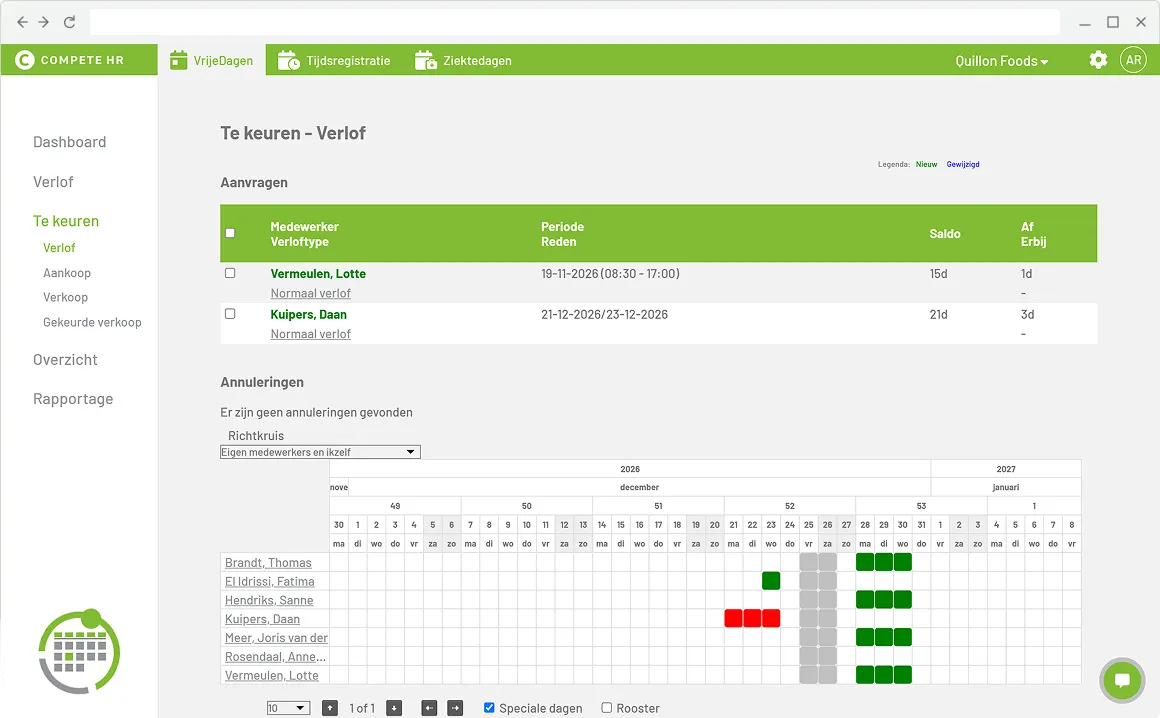
The system is modular: you start with leave and add overtime, sick leave or time registration when you need them. Every user chooses their own language from nine available languages. Leavedays is available from € 2.50 per employee per month (excl. VAT), and you start for free.
Stop doing your leave administration by hand
Request a free trial account and see how Leavedays works for your company.
Frequently asked questions about leave administration
Am I allowed to track leave in Excel?
Yes. In the Netherlands a separate leave administration is not a legal requirement for employers, although a personnel file is. In practice, Excel leads to errors in balances, version problems and privacy risks, especially once your company grows or several people work in the file.
How many statutory holidays does an employee get in the Netherlands?
At least four times the weekly working hours per year, counted in hours. At 40 hours a week that is 160 hours, about 20 days of 8 hours. At 24 hours a week it is 96 hours. Anything above that is extra (non-statutory) leave, agreed in the contract or collective agreement.
When do holidays expire?
In the Netherlands, statutory holidays in principle expire six months after the calendar year in which they were accrued, so on 1 July. This only applies if you informed your employees in time and clearly and they had the chance to take the days; otherwise they remain valid for five years. Extra (non-statutory) days lapse after five years, unless the collective agreement says otherwise.
Is WhatsApp suitable for leave requests?
It works in practice, but you get no balance, no overview of staffing and no fixed place to find approvals. Be extra careful with sick reports: health data is a special category of personal data, and the cause of an illness does not belong in your administration or in a group chat.
What does a leave registration system for SMEs cost?
It differs per provider. Leavedays is available from € 2.50 per employee per month (excl. VAT), and you can try it for free first. The system is modular: you start with leave and add overtime, sick leave or time registration when you need them.
How long should I keep leave records?
The GDPR sets no fixed retention period for personnel data: you keep it no longer than necessary and decide how long yourself. For payroll records the usual period in the Netherlands is seven years. If you are unsure about a specific document, ask your payroll administrator or adviser.
Sources
- FNV – Taking holidays with you and expiry (in Dutch)
- Ondernemen met Personeel – 8 questions about extra holidays (in Dutch)
- HRpraktijk – The duty to inform about expiring holidays (in Dutch)
- De Zaak – What belongs in a personnel administration (in Dutch)
- Ondernemen met Personeel – How long to keep employee data (in Dutch)
- AWVN – Fine for careless processing of personal data (Dutch Data Protection Authority) (in Dutch)
Checked on November 16, 2026. Laws, regulations and collective agreements can change; this article is general information, not legal advice.